In the quiet canalside workshops of Suzhou, a revolution is quietly unfolding in the world of traditional Chinese textiles. The ancient art of kesi, a 2,500-year-old silk tapestry weaving technique often called "carved silk," is being reborn through daring collaborations with contemporary fashion designers. This isn't preservation through museum glass, but rather the vibrant reinvention of a craft once reserved for imperial robes into bold statement pieces for modern wardrobes.
The rhythmic clatter of wooden looms still echoes through Suzhou's historic district, where master weavers manipulate fine silk threads with the precision of surgeons. What has changed dramatically is the final destination of these labor-intensive creations. No longer confined to ceremonial garments or decorative wall hangings, kesi is appearing on Paris runways, New York gallery openings, and the Instagram feeds of style influencers worldwide. This transformation represents more than just aesthetic innovation - it's a fundamental reimagining of how traditional craftsmanship can remain relevant in a fast-paced global market.
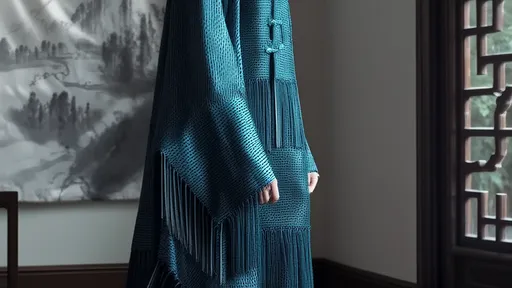
At the forefront of this movement is designer Lin Yao, whose collaboration with fifth-generation kesi artisan Wang Meili has produced startling results. Their 2023 collection featured kesi-woven motorcycle jackets with traditional peony motifs, paired with sleek neoprene accents. "The challenge wasn't just about putting old patterns on new clothes," Lin explains during a fitting session in her Shanghai atelier. "We had to completely rethink the structural possibilities of kesi - how it drapes, how it interacts with modern fabrics, even how it withstands machine washing."
The technical breakthroughs have been as significant as the aesthetic ones. Traditional kesi pieces, woven entirely by hand on wooden looms, could take months to complete a single square meter. Contemporary adaptations incorporate machine-spun silk for base layers while reserving hand-woven kesi elements for focal points. This hybrid approach has reduced production time by nearly 60% while maintaining the distinctive textural quality that defines genuine kesi. "It's like using punctuation in a sentence," Wang Meili describes while demonstrating the technique. "The machine work provides the structure, and our hand-woven elements are the exclamation marks."
Beyond fashion, kesi is finding unexpected applications in interior design and even automotive detailing. A luxury electric vehicle manufacturer recently commissioned kesi-accented dashboard panels, while several boutique hotels in Shanghai now feature kesi room dividers with laser-cut geometric patterns. This cross-pollination between traditional craft and modern industries is creating entirely new revenue streams for Suzhou's artisan community. Young apprentices who might have abandoned the trade are now flocking to workshops, drawn by the prospect of working on innovative projects rather than purely restoration work.
The commercial success stories, however, are underpinned by serious cultural debates. Purists argue that modifying kesi techniques compromises the craft's integrity, while innovators counter that evolution is the only path to survival. The Suzhou Silk Museum has attempted to bridge this divide by establishing clear classification standards - "Heritage Kesi" for pieces made entirely through traditional methods, and "Contemporary Kesi" for hybrid creations. This nuanced approach appears to be satisfying both conservation and innovation camps, at least temporarily.
Perhaps the most telling indicator of kesi's successful transition into modernity lies in its changing customer base. Where once the primary buyers were collectors and cultural institutions, today's clients include tech entrepreneurs seeking distinctive office decor, brides wanting unconventional wedding dresses, and even streetwear brands looking for unique textile effects. The price points have democratized too, with small kesi-accented accessories starting around $200, making the craft accessible to younger consumers.
As sunset gilds the canals of Suzhou, the looms in Wang Meili's workshop continue their steady rhythm. But the products taking shape represent a bold new chapter for this ancient craft - a cropped kesi jacket destined for a Milan photoshoot, a set of luminous wall panels for a Dubai hotel, and experimental swatches combining silk with recycled plastics. In these threads, one can trace not just patterns, but the very future of Chinese cultural heritage in the global design landscape.

By /Aug 13, 2025

By /Aug 13, 2025

By /Aug 13, 2025

By /Aug 13, 2025

By /Aug 13, 2025

By /Aug 13, 2025

By /Aug 13, 2025

By /Aug 13, 2025

By /Aug 13, 2025

By /Aug 13, 2025

By /Aug 13, 2025

By /Aug 13, 2025
By /Aug 13, 2025
By /Aug 13, 2025

By /Aug 13, 2025

By /Aug 13, 2025

By /Aug 13, 2025
By /Aug 13, 2025

By /Aug 13, 2025
By /Aug 13, 2025
